Reflections on IPDGC’s Origins, Vision, and Future, by Bruce Gregory
Both had distinguished careers with the US Information Agency (USIA). Barry had been USIA director Edward R. Murrow’s choice to head the Joint US Public Affairs Office in Vietnam. In retirement he was a senior executive at Time magazine. Walter had been Ambassador George Kennan’s PAO in Yugoslavia and the only presidentially-appointed career diplomat to serve on the US Advisory Commission on Public Diplomacy. Steve Livingston, Barry Fulton, and I attended the meeting. Keep this in mind. We’ll come back to it later.
The Institute’s roots are deeper. In post-Cold War US public diplomacy. And here at GWU.
In 1988, two former USIA directors, John Reinhardt and Leonard Marks, a handful of retired career officers, and Yale historian Robin Winks created a small nonprofit called the Public Diplomacy Foundation. Its goal was to support the academic study, professional practice, and citizen awareness of public diplomacy.
A decade later — in the late 1990s — the energetic Zorthian was the Foundation’s president. Its name would soon change to the Public Diplomacy Council. And today it’s the Public Diplomacy Council of America.
One of the Council’s top priorities was to find a partner at a Washington area university — comparable to the Murrow Center for Public Diplomacy at the Fletcher School of Law and Diplomacy.
USIA had been giving its officers university year assignments at Fletcher for decades. And, at the National Defense University and military service colleges. Many returned to top leadership positions in the Agency. USIA understood the value of professional education.
As the PD Council was looking for a university partner, a handful of recent USIA retirees were embarking on second careers in teaching and academic research. They wanted not only to teach practitioner-oriented courses — but to develop public diplomacy as a field of academic study. They included:
- Donna Oglesby who taught for years at Eckerd College.
- Mike Schneider, the long-time director of Syracuse University’s Washington program.
- Juliet Sablosky taught cultural diplomacy courses — and Ambassador Pamela Smith taught public diplomacy courses — at Georgetown.
- Barry Fulton taught courses here at GW’s SMPA and for a year headed its political communication section.
I came to SMPA as an adjunct professor after 3 years of teaching at the National War College.
American University and Georgetown welcomed courses on public diplomacy, but neither was interested in a PD Center. GWU was a different story.
Walter Roberts had taught public diplomacy courses for 10 years at the Elliott School. His close friend, Mickey East, had been the Elliott School’s dean from 1984-1995. Mickey became an Institute board member, and he later chaired the Walter Roberts Endowment.
SMPA Professor Jerry Manheim had published Strategic Public Diplomacy and US Foreign Policy in 1994. One of the first academic books on the topic. It’s still a good read. Steve Livingston was doing pioneering work on the CNN effect. We met when he came to the War College to give guest talks in my PD and media courses. With support from then SMPA director Jean Folkerts, Steve became the driving force in creating a Public Diplomacy Institute at GW. Without his efforts there would be no IPDGC.
Now back to that Metropolitan Club meeting. After several hours of conversation, we had developed plans for a Public Diplomacy Center. To be sponsored jointly by GWU’s School of Media and Public Affairs and the Public Diplomacy Council. A few months later, in July 2000, Steve, Jean Folkerts, Barry Zorthian, and Ambassador Tony Quainton, the Council’s Vice President, signed a Memorandum of Understanding formalizing the partnership.
Soon the Center had an office that Barry Fulton and I shared with computers, file cabinets, front office support, and auditorium access in SMPA’s then brand-new high-tech building — conveniently located just a few blocks from the State Department.
Steve invited the Elliott School of International Affairs to co-sponsor the Center. At GW two academic sponsors meant it would be a Public Diplomacy Institute. Steve chaired the Institute’s board. Barry Fulton was its first director. At the board’s inaugural meeting in May 2001, there was equal representation from GWU’s SMPA and Elliott School faculty -- and members of the Public Diplomacy Council.
The new Institute’s scholars and practitioners had two primary goals. First, to advance academic study and professional practice through teaching, research, scholarship, publications, academic conferences, and public forums. Second, to offer expertise and collaborate with scholars, practitioners, government organizations, and civil society groups in the US and abroad.
It was ten years after the Cold War. Two years after USIA had been abolished. And two years before former VOA director Geoff Cowan and others launched the University of Southern California’s Center on Public Diplomacy in Los Angeles. Collegial relations began immediately — and still exist — between these east and west coast PD organizations.
The Institute’s founders honored past achievements in public diplomacy. But they didn’t spend time trying to recreate USIA. Their focus was on public diplomacy’s future. That future quickly brought the terrorist attacks of 9/11. Wars in Afghanistan and Iraq. New digital technologies. The rise of social media. Many more diplomatic actors in governments and societies. And an expanding array of transborder threats.
The Institute launched a variety of activities, most of which continue today.
Its members taught academic courses. And mentored US and international students. It hosted public forums with figures such as former Under Secretary for Public Diplomacy and Public Affairs Karen Hughes and talks with the Director General of Canada’s Public Diplomacy Bureau.
It sponsored visiting research scholars. And hosted academic roundtables with leading US and international scholars. Such as Britain’s Mark Leonard and Brian Hocking, and the Netherlands’ Jan Melissen.
Barry Fulton developed two 4-week professional post-graduate courses for the Kuwait Information Service. Classes were taught by GWU faculty and Institute practitioners. Steve Livingston developed media courses for China’s diplomats in Washington.
The Institute’s faculty contributed to public diplomacy reports by the Defense Science Board, the GAO, Congressional Research Service, and other organizations. They advised:
- Lawmakers.
- State Department appropriations chair Frank Wolf.
- House Armed Services committee member Mac Thornberry.
- And House and Senate foreign relations committee staffs.
The Institute established the Walter Roberts Endowment with a generous lead gift from Walter and contributions from other former practitioners. And began its annual Roberts Endowment lecture series. Distinguished speakers included former NSC advisor Brent Scowcraft, the late Joseph Nye, and Ambassadors Thomas Pickering and Michael McFaul.
In 2005 Barry negotiated an agreement with the State Department to send PD Fellows to GWU. For 20 years — until it was suspended this past summer — Foreign Service officers have been teaching courses, hosting forums, mentoring students, and providing insights on the practice of public diplomacy. I consider this the Institute’s flagship initiative.
In 2008, IPDGC established a new M.A. degree program in Global Communications.
The Institute’s focus from the beginning has been global and multidisciplinary. Given its location and history, it of course has strong ties with US diplomats and organizations. But importantly, it also participates in a broader discourse that connects multiple academic disciplines with practitioners in government ministries, embassies, and civil society organizations worldwide.
A panel of former IPDGC directors will discuss its role and achievements later in the conference.
Let me close with two thoughts looking to the future.
First, GWU has a role to play as diplomacy’s practitioner communities increasingly realize they must develop learning cultures. And opportunities for career-long professional education. Foreign ministries in many countries — including the State Department briefly and until recently — have come to understand that diplomats cannot rely only on skills training, on what they learned in college, and on the job experiences.
No practitioner — or foreign ministry — can have deep knowledge of all of today’s complex issues. Climate change. Pandemics. Cyber threats. Big data. Global finance. Disinformation. Geopolitical tensions. And of course, A.I. You know the list. Senior US diplomats — such as William Burns, David Newsom, and Marc Grossman — have been writing about this in recent years. They understand that the military has long valued professional education — and that learning opportunities away from the pressures of daily activities are essential for diplomats and other practitioners.
At GWU and in other epistemic communities, diplomacy practitioners gain from exposure to:
- Diverse analytical perspectives.
- New technologies.
- Critical and innovative thinking.
- And trends in operational environments.
It’s a two-way street. Scholars benefit from dialogue with practitioners — and from research on what practitioners in diplomacy and the media do in their daily activities.
In diplomacy today:
- There is more engagement by government diplomats at home.
- Greater participation by citizens in diplomacy abroad.
- And near universal acceptance of public diplomacy as a central element of everyday diplomatic practice.
This is what forward leaning scholars call “societized” diplomacy. A central component of this trend is what scholars describe as “diplomacy’s domestic dimension” — or “home engagement in diplomacy” — diplomacy as a process in which state-society interactions are increasingly central in addressing global problems. The growing centrality of state-society relations in diplomacy will take its academic study beyond international relations and communications to fields across the social sciences and humanities.
These ideas are developed by thought leaders in a forthcoming book that Kathy Fitzpatrick and I have enjoyed co-editing, Diplomacy’s Public Turn: Prospects for Theory and Practice. She will be talking about it later in the conference.
GWU is well suited to lead in societiezed diplomacy. The Institute’s core advantages are in its faculty expertise in media studies, digital technologies, and A.I. And its home in SMPA and the Elliott School. But it is also housed in the Columbian School of Arts and Sciences where courses in sociology, anthropology, psychology, and the humanities can be leveraged to future advantage.
A second thought looking to the future is that GWU and the IPDGC — perhaps not without some risk — can provide much needed civil discussion on polarizing issues in diplomatic practice. On problems in mediated discourse. On controversies now challenging liberal democracies. And on diplomacy in crisis.
For decades, universities, advisory panels, and creative practitioners worldwide have played a vital role in changing patterns of practice in public diplomacy and global communication. They did so during the 20th century’s hot and cold wars. And after 9/11. As leaders and citizens episodically “re-discovered” the value of public diplomacy.
They must do so now when the US and some other countries are systematically dismantling diplomacy’s institutions, defunding its activities, and subverting its career services. When populism and illiberalism are ascendant. When new and complex geopolitical conflicts and global problems elude cross-border solutions. When A.I. technologies are changing faster than strategies and operational decisions. And creating a crisis in knowing what is true and real.
Today, IPDGC remains focused on the future — as can be seen in this conference’s agenda. The Institute is well positioned to meet these challenges at the crossroads of diplomacy, society, and academic study.
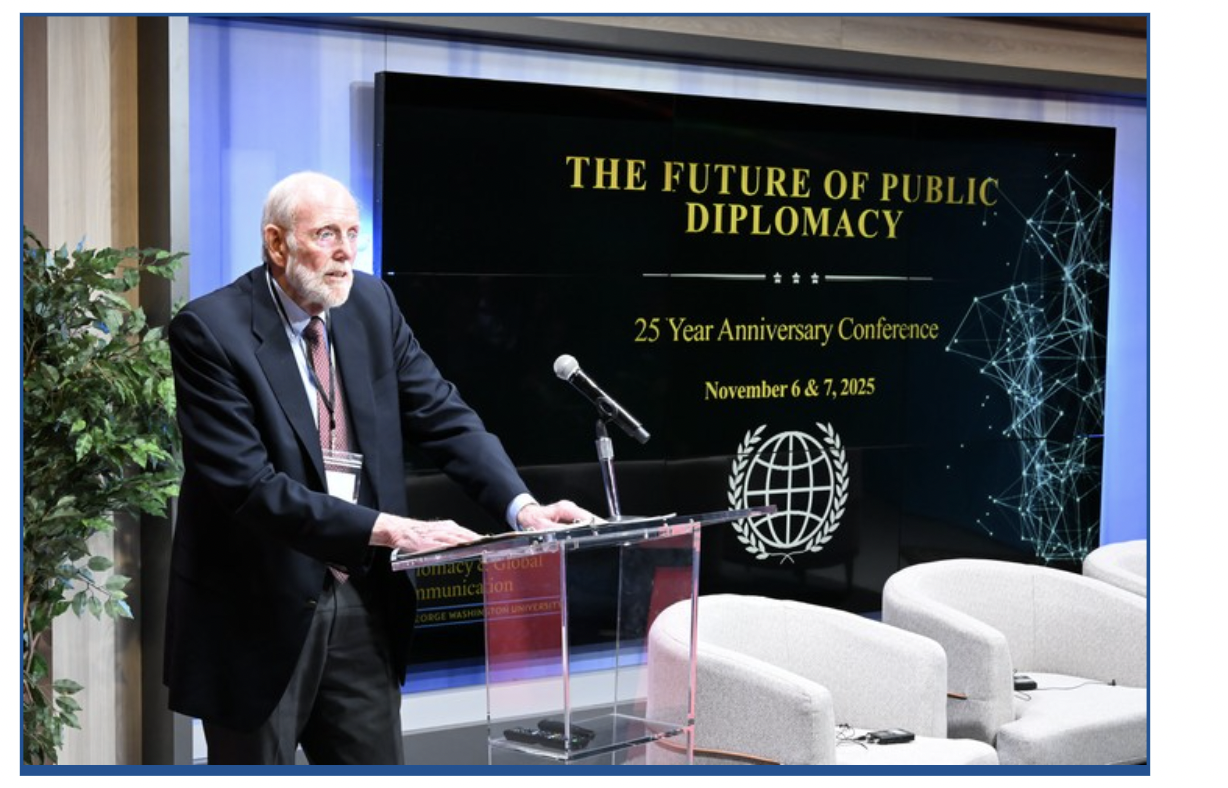
These remarks were delivered at George Washington University on the occasion of the observance of the 25th anniversary of the founding of the Institute for Public Diplomacy & Global Communication on November 6, 2025. A version of these remarks was prepared for the IPDGC blog and is available here.
Bruce Gregory is an affiliate scholar at George Washington University’s Institute for Public Diplomacy and Global Communication.