Reading Tea Leaves: Trump II’s First National Security Strategy - Bill Wanlund's Worth Noting
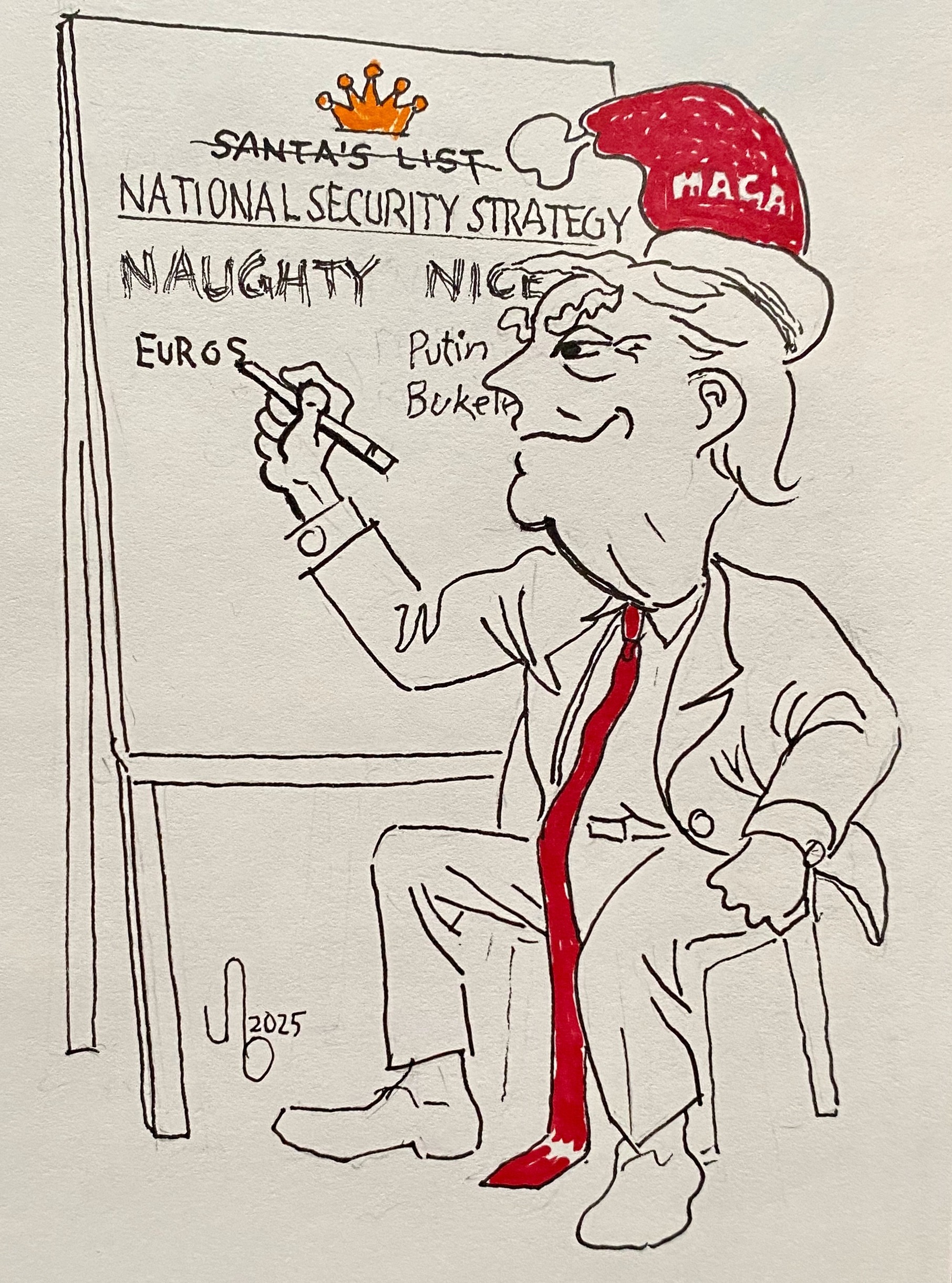 The December 7 Release of the Trump Administration’s first National Security Strategy (NSS) had Washington’s foreign policy establishment abuzz last week. Think-tank pundits were locked and loaded, chained to their keyboards, serious faces in place, ready to analyze the heck out of what this most unconventional of presidents was going to say about America’s strategic relationship with the rest of the world – and how the rest of the world would react to it.
The NSS is a Congressionally-mandated compendium of the global issues affecting the United States, and the economic, political, and military resources necessary to address them. It’s of particular interest to foreign-policy analysts and administration-watchers in the aforementioned think tanks, and, for the media, for the guidance it provides to current administration thinking about issues and, more broadly, geographical regions. Embassy public diplomacy officers need to be familiar with it as they plan and shape press and cultural events to support Administration objectives.
This year, foreign affairs pundits were seized by the NSS’s apparent relegation of Europe, from its traditional primus inter pares position to virtual also-ran. Emily Harding, director of the Intelligence, National Security, and Technology Program at the Center for Strategic and International Studies (CSIS), put it cogently in her analysis, The National Security Strategy: The Good, the Not So Great, and the Alarm Bells: “This NSS is a real, painful, shocking wake-up call for Europe. It is a moment of cavernous divergence between Europe’s view of itself and Trump’s vision for Europe…. This “[NSS] marks an ideological and substantive shift in U.S. foreign policy. The administration is attempting to define a new ‘America First’ foreign policy doctrine that is deeply pragmatic, and perhaps short-sighted. For example, the democracy agenda is clearly over. Foreign policy choices will be made based on what makes the United States more powerful and prosperous. That’s fair, and clearly what the American people voted for, but today’s self-interested choices may lead to a far lonelier, weaker, more fractured future.”A few blocks from CSIS, the Brookings Institution was turning 19 of its foreign policy experts loose for a series of bite-sized critiques of different aspects of the NSS. Leadoff hitter was Scott Anderson, a Brookings Fellow and General Counsel and Senior Editor at The Lawfare Institute. He sees a noticeable departure from previous NSSs, and writes, “The current Trump administration’s new national security strategy departs from the explicit focus on major power competition shared by its two predecessors.”
“The first Trump and Biden administrations both framed China and Russia’s desire to ‘shape a world antithetical to U.S. values and interests’ as a leading foreign policy concern,’” Anderson writes. “China was a long-term ‘pacing challenge’ in the competition for global influence, while Russia was an ‘acute threat’ actively engaged in ‘subversion and aggression.’”
“By contrast,” says Thompson, “the new NSS does not expressly reference major power competition once. And it adopts a notably more conciliatory tone toward competitors, framing the challenge as ‘managing European relations with Russia’ and working to ‘rebalance America’s economic relationship with China.’ Meanwhile, it frames ‘the outsized influence of larger, richer, and stronger nations’ as ‘a timeless truth of international relations, which in turn leads the United States to ‘reject the ill-fated concept of global domination’ in favor of global and regional balances of power.’ The implication is that the United States is less intent on strategic competition and more open to spheres of influence.”
Summing up, Anderson remarks that “the worldview underlying the new NSS appears to be quite a departure from what has guided U.S. foreign policy for the past decade. That may in turn portend more substantial changes down the road.”
Kori Schake, Director of Foreign and Defense Policy Studies at the conservative American Enterprise Institute, argues in Foreign Policy that the NSS “is a moral and strategic disaster.” In fact, she says, it isn’t a strategy at all, but “a statement of values. And those values are vandalism against the very things that have made the United States of America strong, safe, and prosperous.” As an example, Schake notes that the first vital interest listed in the NSS is to ensure a “stable and well-governed” Western Hemisphere “to prevent and discourage mass migration to the United States.”
Another of Schake’s gripes is that the NSS “makes no attempt to explain how President Donald Trump’s domestic policies, such as the moves against university independence or aggressive deportations, will impact the country’s ability to sustain [its] advantages. Nor does it orchestrate those assets into actual strategy. Instead, it lists principles such as ‘flexible realism,’ without explaining how that will be translated into policies and budgets.”
In conclusion, Schake writes, “what this ‘strategy’ does make clear is that the only war that the Trump administration wants to fight is a culture war. And it sees the United States’s adversaries as partners in that war, but it does not see how much U.S. power relies on the voluntary assistance of other countries.”
Bill Wanlund is a PDCA Board Member, retired Foreign Service Officer, and freelance writer in the Washington, DC, area. His column, Worth Noting, appears occasionally in PD Today and the PDCA Blog; it seeks to address Public Diplomacy and related topics of interest to all.