Of Values and Narratives, by Bill Wanlund
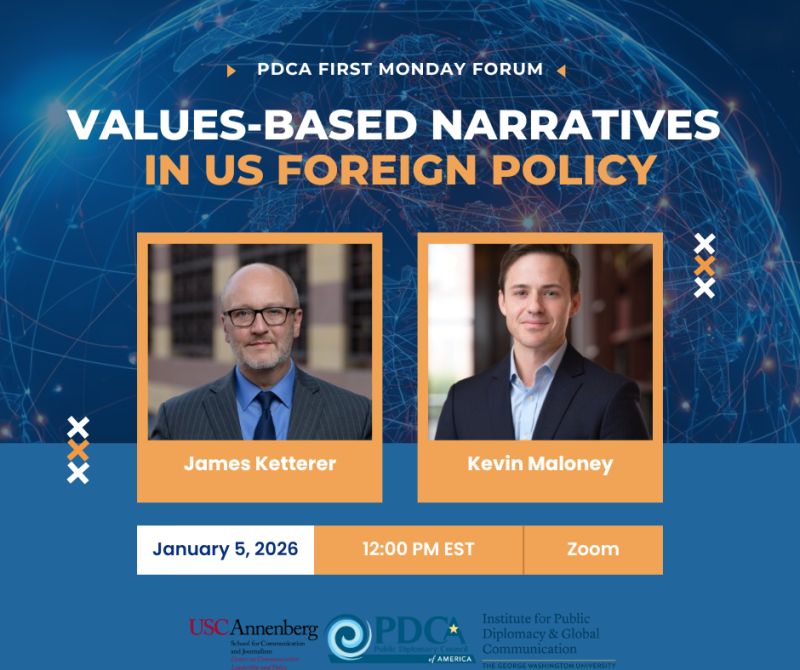
Q. What are liberal and illiberal values?
A. Kevin – Post-World War II, liberal values such as peace, freedom, pluralism, etc., and the associated principles of sovereignty, democracy, human rights, and multilateralism, served as key elements in the geopolitical narratives projected by the U.S. These narratives were underpinned by a commitment to the equal moral worth of every individual, both at home and abroad. In short, the U.S. sought to craft narratives that drew on liberal values and related principles of action, new rules of the road for the international community.
Take a specific value, such as cooperation, which informed the foreign policy principle of multilateralism. Obviously, the U.S. didn’t prioritize multilateralism as a policy out of altruism. There were significant power dynamics at play. But in multilateralism, the U.S. found a policy prescription that both aligned with a liberal value of cooperation and helped to secure its security interests.
At Carnegie Council, we explore the foreign policy spectrum between liberal idealism and amoral realism, or how institutions can operate in a manner that recognizes and prioritizes power dynamics and related interests, while not abandoning values-based concerns or ethical responsibilities.
Today, U.S. foreign policy narratives have taken an illiberal turn. We’re seeing more hostility toward concepts such as human rights and multilateralism. The gap between liberal and illiberal values-based narratives is becoming increasingly clear, often manifesting as a rejection of traditional diplomacy, reciprocity, and liberal soft power.
Jim – I’ve become enmeshed in the institutions of the U.S. Government and other institutions that have flowed from the values and the narratives that created and supported them. Some of these institutions have been gone for a while, like USIA, others departed more recently, like USAID. But consider the initial value system that created them and the narratives flowing from those values and I think you can see a tangible outcome of what Kevin is talking about.
Q – Why is this shift happening now?
Kevin – In our research examining the norms and values underpinning U.S. foreign policy narratives, we found a clear ossification around the very concept of “values” – not only within the policy community, but also among the domestic audiences those narratives are often meant to reach. By ossification, I mean that in the last eighty years, we have increasingly conflated values with liberal values.
Every government and every leader throughout history has sought to project a particular values system, often ones that were explicitly anti-liberal and anti-pluralistic. Today we're witnessing a transition between dominant values systems: while there are points of overlap, a distinct set of liberal values is increasingly in contest with a distinct set of “America First” values.
Key examples of these emerging illiberal-values-based narratives in U.S. foreign policy are Vice President Vance's speech at the Munich Security Conference last February and in the pages of the recently released National Security Strategy. For the first year of Trump 2.0 foreign policy narratives, the Vance speech was the appetizer; the NSS the full course.
In this administration, there’s been a strong turn towards values-centric identity narratives infused with concepts such as “Western” values or civilizational erasure. It's a clear attempt to make an illiberal, values-based foreign policy argument because the administration believes there is domestic political and international advantage to be gained from such an approach.
Jim - In this contestation of values, you find narratives and terminology that seem to resonate but actually mean something quite different. The Vice President wagging his finger at the Munich Security Conference and talking about American concerns about European constraints on free speech seems to reflect earlier times, but is actually constructed as an overarching narrative toward a much different political goal.
I've had the good fortune of working for some people who belong in any Foreign Service Hall of Fame. The first one I worked for was (PDCA member) Bob Gosende, who taught me a tremendous amount about public diplomacy programs constructed in a way that are not” just a program,” or “just another thing to do,” but heavily infused with values. Working with Bob let me see how the narratives that underpinned American foreign policy at that time, as Kevin described, were closely woven into those specific programs and the ways in which we implemented those programs.
Q – Let’s hear more about the current Administration.
Kevin – We’re interested in understanding the narrative ecosystem of the Trump administration because there are multiple factions that see the world differently: You have the Vances, the Rubios, the Hegseths, etc., and how they prioritize certain audiences and values in their discourse is quite interesting. You see this manifest in a number of ways: Hegseth’s embrace of masculine hard power as a prescription for the moment; Rubio's embrace of anti-authoritarianism and anti-communism; Vance really going into the civilizational warfare, Western values, U.S. vs. Europe approach. While there are many areas of overlapping values and narrative, there are also points of difference to identify.
That’s where the Trump presidency has not only domestic effects, but massive ripple effects internationally. For nearly 80 years, the U.S. has helped set the international strategic narrative through a liberal lens. As this administration pushes back, narratively, against a system it no longer sees as fit for purpose from an America First perspective, the question becomes: what is the outward impact? This is a particularly interesting moment to map the different stories various administration actors are attempting to tell – sometimes strategically aligned with each other, sometimes not.
Jim – In the immediate post-Cold War environment, when the U.S. and others were convinced that democracy was breaking out all over, we spent a lot of time working on USAID democracy and governance projects under the George W. Bush administration. He came into office vowing he was not in the nation-building business, and then I and many others spent several years nation-building on behalf of the United States. In that post-Cold War, and then post-9-11, context, it’s important to put this current moment in perspective.
It's also important to put the broader trends that we see that the United States is part of right now together with what's going on in the rest of the world. That end-of-history, breakout-of-democracy world of the 1990s, and even into the post-9-11 era, turned out to be a blip in time. The list of countries that are now putting into place some authoritarian or right-wing regimes or where they appear poised to do so I think is compelling.
Q – Is the U.S. becoming an autocracy?
Kevin – From an ethical perspective, which is our focus at Carnegie Council, any attempt to fracture any sense of shared values is not only anti-pluralist but also a historically proven pathway to conflict. Internationally, we’re starting to see the echoes of U.S. increasing domestic illiberalism play out on the global stage.
Jim - One difficulty in answering your question is that many Americans have a basic visceral assumption that autocracy is some clear destination, where you've reached the city limits and a sign says, “Welcome to Autocracy.” I’ve lived in places that are certainly full-out authoritarian regimes by any definition, and in such regimes, life goes on: people are raising their kids, they're going to school, they're trying to get promotions, they're celebrating holidays.
The dichotomy between living one's life on an everyday basis and the nature of the overarching regime I think is something that many Americans don't realize, because they haven't had an experience like that. They don't really understand the pace at which this all happens – it’s incremental, can be slow, sometimes fast, but it's not clearly defined in the way that I think people expect it to be.
In a recent interview, former Columbia University President Lee Bollinger remarked on a general “failure of imagination” to understand the enormity and the potentially dire nature of such shifts. That reflects that tension between living one's daily life and then trying to ponder these broader, sometimes overwhelming political issues at the highest level, and then just reverting to, ‘Okay, that's all well and good, but what's for dinner?’ I think Bollinger was right about a failure of imagination of people who are generally not supportive of what's going on, but still not fully grasping the situation.
Kevin – Taking all this back to the nuts and bolts of the project: Empirically, you can see the narrative overlap that’s happening right now between the current administration and narratives from autocracies or illiberal democracies. For example, you see the narrative overlap between how the Trump administration talks about “illegals” and how Viktor Orban's administration talks about migrants, or between how Russia talks about the weakness and moral bankruptcy of the UN and how the Trump administration talks about international institutions.
This narrative overlap didn’t seem imaginable 10 years ago; yet now it's playing out in real time. You can look at one set of narratives from a traditionally liberal country, compare those to a set of narratives from an autocratic state, you can analyze those narratives, and you can find overlap. That
analysis is there for all to see. That’s the benefit of looking at narratives: inherently, they have to be public-facing, and people will draw their own conclusions.
Jim - The narratives may be public facing, but the ways in which they’re used may mask the underlying values.
Kevin – The father of modern realism in international relations, Hans Morgenthau, discussed moral masking in the practice of geopolitics: every actor seeks to assume the moral high ground as a means to achieve a political end. Today, we find ourselves in a period of contestation around values. Citizens still gravitate toward language that invokes “democracy” and “freedom of speech,” but we are increasingly seeing obfuscation of what those concepts have traditionally meant.
Liberal values remain pillars of U.S. foreign policy narratives, but actors are increasingly seeking to rewrite those concepts to advance illiberal political ends, where pluralism and multilateralism are no longer central principles.
Q – What’s next?
Jim - We need to engage the broader American public more fully on what foreign policy and its institutions are, why they do what they do, and why they’re important. Kevin and I want to ensure our work goes beyond our sessions at the Council because what we're discussing is bigger than what's happening in Washington. We were just up in the Hudson Valley of New York talking to the local World Affairs Council. Organizations like that let us reach audiences beyond those we have already engaged. A liberal values-based approach to international relations pays greater dividends in the long run, from both a national and an international security perspective.
Bill Wanlund is a PDCA Board Member, retired Foreign Service Officer, and freelance writer in the Washington, DC, area. His column, Worth Noting, appears occasionally in PD Today and the PDCA Blog; it seeks to address Public Diplomacy and related topics of interest to all.