Tragicomic Theater: The First Hearing After Nearly Half a Year for Under Secretary Rogers, by Lynne Weil
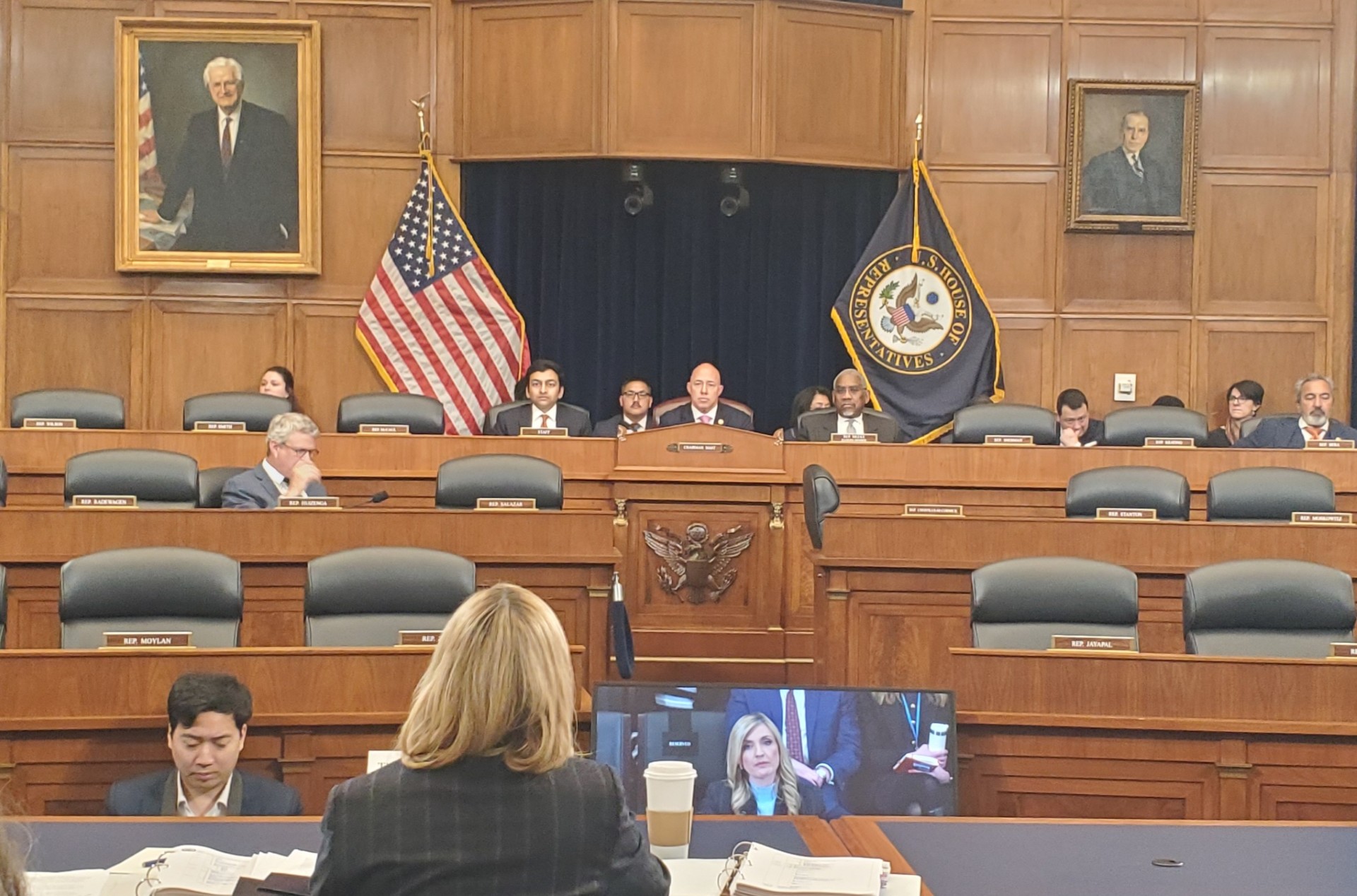
Under Secretary Sarah B. Rogers was the witness, backed by the customary phalanx of State Department staff and armed with the usual background info binder. Five months into the job, she showed passion in her prepared statement and throughout the proceedings for the goals of PD in which she’d previously voiced interest, among them promoting free speech, but scant command of foreign policy nuance or support for more than a few of the broad range of tools at her office’s disposal.
She dodged the most salient issue that was repeatedly raised – the mess of official messaging about the war this country had suddenly started with Iran during the previous week – and deflected several House members’ questions by temporizing, interrupting, and other tactics reflecting her background as a big-time attorney.
And she gave oxygen to incendiary comments from committee members on just one side of the aisle about previous administrations’ efforts to promote respect for the spectrum of humanity through PD; “transgender” and “DEI” came up a weirdly high number of times.
On that last point: Every congressional committee raises legitimate inquiries about efficient use of U.S. taxpayers’ hard-earned dollars. Members of the party in power in the White House traditionally mute their concerns in hearings and other public forums, while the opposition goes at it with gusto. And it’s fair game to slam past practices. But to do so again and again, at times dropping into the hearing room to raise the exact same examples that already had been invoked and then to get up and leave, is theater. And the matters before this committee deserve better than a tragicomic show.
Ranking Member Gregory Meeks was the first to point out that HFAC had not had “one single administration witness testify publicly on Iran for the past year.” As he noted, “the American people deserve to know why this President has taken us to war, what the objectives and nature of the imminent threat are, and how much it will cost them.”
Representative Meeks then observed that “public diplomacy is not symbolic. It is our frontline tool for ensuring the United States – not China, not Russia – shapes how billions of people understand democracy, freedom, and American values. It’s how we counter foreign disinformation and propaganda, demonstrate U.S. leadership, and win hearts and minds.” And amid an acrimonious back-and-forth with the witness, he said “if the administration can’t get its message straight” for the people of the United States on its goals and rationale regarding Iran, “I can only imagine it’s worse overseas.”
Other HFAC members on both sides of the aisle raised questions about messaging on Iran and the means by which it’s being disseminated, especially after the administration’s attempts – some blocked by Congress and others by courts – to dismantle U.S.-funded international media such as Voice of America and Radio Farda, run by RFE/RL. One member had a Washington Post column about it inserted into the record.
Also placed in the record: numerous items from unnamed outlets about the aforementioned PD programs promoting diversity, and in particular gender nonconformity, that recently were discontinued but evidently live on in vivid memory. Mentions of these items served momentarily to shift the conversation away from the government’s shortcomings in connection with Iran. It’s almost as if that was the intent all along.
More than one member of the committee questioned whether Rogers was the right person to speak about U.S. government messaging regarding Iran or anything else. The Under Secretary herself provided an opening by pointing out that amid conflicts, close interagency coordination sets the content and tone for what gets said to the world, and when. But Rep. Joaquin Castro (D-TX) took it a step further: “You’re saying that they have sidelined you? … By statute, you and your office have an important role to play. Unfortunately, this administration doesn’t seem” to agree.
And as many PD practitioners know all too well, it has often been the case that the Under Secretary for Public Diplomacy, statutorily empowered to lead outreach to audiences abroad and ensure other agencies’ alignment with this leadership, has instead been unheard, ignored, or even undermined.
That said, several HFAC members gave shoutouts to aspects of PD that have proven both successful overseas and popular with Congress. These included the work of Radio Free Asia – decimated by the administration’s attempt to dismantle it, but gradually regaining strength with funding restored by the Hill – and educational exchanges, battered though they’ve been by State Department reorganization, grant suspensions, and funding cuts in recent months.
Sports diplomacy got some love from Rogers and a couple of California-based HFAC members who are especially invested in the success of the L.A.-based Summer Olympics in 2028. Other members aware of the benefits of PD programs to their districts as well as the rest of the globe praised J-1 visas, anti-censorship tools, and online efforts around the clock to counter malign influence from abroad.
In opening remarks, South and Central Asia Subcommittee Chairman Bill Huizenga (R-MI) proposed enhancing the Bureau of Global Public Affairs as it pivots from previous online engagement efforts to counter malign influence from China – and, one might add, Russia, extremist groups, and other non-state actors.
“Defend the free flow of information and creatively use technology to overcome information barriers to reach people,” he said. “The bipartisan foundation is here. It’s critical” that further strengthening of GPA be done right.
This could mean targeted legislation is on its way. In any case, it wouldn’t be surprising to see some sort of PD bill or provision emerge, since hearings often set the stage for new measures. And we can expect other forms of follow-up, as there were numerous Questions for the Record – to be answered in writing normally, or, if touching on sensitive national security matters, in briefings behind closed doors.
Which brings us back to the hearing title and the witness’s expertise.
When facing the Senate Foreign Relations Committee last April amid the drawn-out process of her confirmation, Rogers said in carefully prepared remarks that freedom of speech “furnishes our best response to rivals, like Iran and the Chinese Communist Party, who want to replace the free exchange of ideas with distortions scripted by the state.”
After her move to Foggy Bottom, she made nauseating waves by meeting with far-right European politicians and trash-talking measures taken against hate speech overseas and at home. More recently, she has echoed this administration’s rising call to dismantle the “Censorship-Industrial Complex” by various means, backed its move to deny potential visitors visas based on social media posts, and supported deporting foreign students for taking part in college campus protests.
HFAC members called out these gross affronts from just after the hearing's start to just before its end, when Rep. Pramila Jayapal (D-WA), a first-generation U.S. citizen who’s both vocal and legislatively active on immigration matters, initiated a telling exchange.
“Over the last year, we’ve seen the State Department go after free speech rights, revoking student visas for speech that the Trump Administration doesn’t like," she said. "... Do you think you can effectively maintain our global reputation while your own department is cracking down on the free speech rights of people right here at home?”
The former “law-firm partner and free speech activist” took issue with the framing of the congresswoman’s subsequent comments, talked over her repeatedly in rapid fire, and summed things up this way: “Even if a critical op-ed got you deported from America, you would still be better off writing a critical op-ed in America than anywhere else.” Hmmm.
Under Secretary Rogers defended her points vigorously and mostly knowledgeably. She leafed through her background binder only a couple of times to answer questions. And to my relief, it wasn’t to dredge up bombshells from a “burn book” like the one Attorney General Pam Bondi consulted repeatedly during a different but in some ways similar House hearing last month.
But her otherwise dismaying behavior, both here and on occasion during the past half-year, makes one wonder what’s next on the horizon for the person who allegedly “enhances national security by expanding and strengthening the relationship between the people and Government of the United States and citizens of the rest of the world.” Stay tuned: Apparently, according to this key administration official, a PD strategic plan is to be released next month.
(Photo: Courtesy of the author)