Where Will the Next Generation of China Hands Come From? By Beatrice Camp
Before he departed his ambassadorial assignment in Beijing in January 2025, Ambassador Nick Burns asked public diplomacy staff to determine how many U.S. students were studying in the People’s Republic of China (PRC). Contacting Chinese universities, they came up with 1,104, a huge decrease from 11,000 in 2019.
Ambassador Burns recounted this outcome while helping to introduce a recent report by the U.S.-China Educational Trust titled “America’s China Talent Challenge: Investing in Deeper American Understanding of China.”
The report drives home the alarming reality that “the United States is losing its bench of China expertise at a moment when it can least afford to…the talent pipeline feeding our government, universities, and private sector is under serious strain.” A table from IIE shows the extent of the decline.
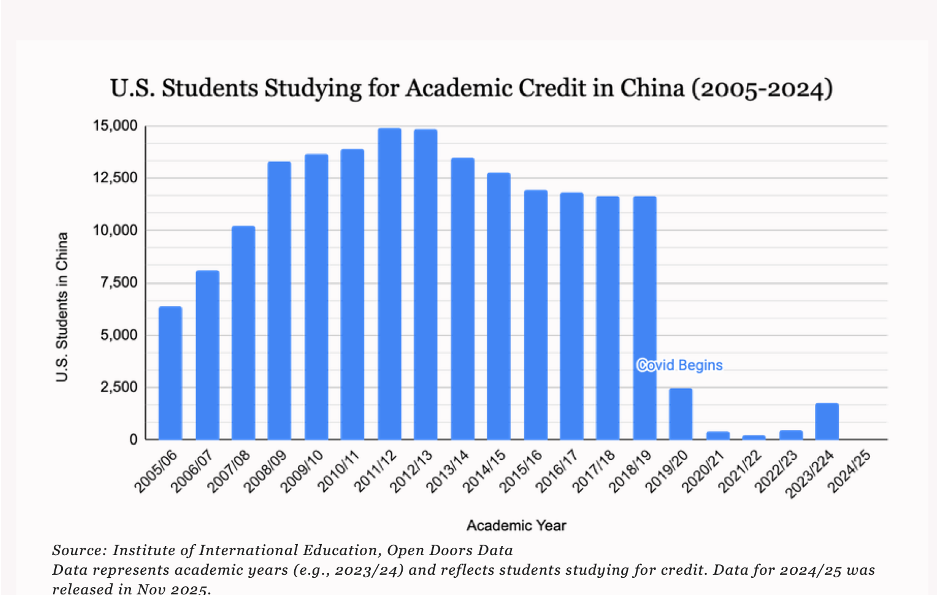 The reasons behind these low numbers are many, with origins on both sides. The environment in China has become more restrictive, while in the U.S, “federal funding for China-focused study has declined sharply and many longstanding exchange programs have been suspended.” Plus many students worry that studying in the PRC may hurt their future chances for government careers.
Fulbright programs in China and Hong Kong were terminated in 2020 by the president, with few optimistic about a restart any time soon. Peace Corps as well as Gilman and other fellowships in China were canceled at the same time.
The director of the Fulbright program in Taiwan, himself the beneficiary of a two-year teaching fellowship in the PRC, expressed deep concern “that the people-to-people ties that have brought Chinese and Americans together for so long…are deeply frayed.”
Although Taiwan is now attracting increased grant applicants and Mandarin student enrollments, he nevertheless fears that “we are losing a generation of young Americans who will not gain the language and cross-cultural interpersonal skills that are so important.”
The USCET working group made eight recommendations to address the challenges to rebuilding our China bench.
- The U.S. government should publicly recognize the need to sustain America’s expertise on contemporary China and signal its support for educational exchanges. Statements of support from government officials for study in China would reassure students, faculty, and administrators that it is in the national interest to take part in and conduct educational programs in China.
- We should encourage Chinese officials and education leaders to welcome and facilitate the work of Americans pursuing social science and humanities research in China.
- U.S. government agencies need to provide guidance for students on the security clearance process, making it clear that training in China does not disqualify students from future work in the government.
- Higher education leaders should work with U.S. policymakers to ensure that students and scholars traveling to China are adequately prepared pre-departure for social media and other restrictions they will face.
- U.S. federal requirements protecting against security violations should seek to mitigate risk without obstructing connections, e.g. allowing greater leeway in the social sciences than in STEM fields.
- Policymakers and academic leaders should support existing American academic centers in China, such as the Hopkins-Nanjing program in Nanjing or NYU’s Shanghai campus.
- The U.S. and China should have regular bilateral diplomatic consultations on these issues; in addition, the USG should coordinate with stakeholders in China, encouraging universities and educational organizations to share information and develop collaborative approaches to common challenges.
- The government should restore and expand federal funding for Chinese-specific language and research provided by the Departments of State and Education for study in the PRC.
As Ambassador Burns noted in his opening remarks at the launch of the working group report, he benefited immensely from an experienced embassy staff with great China expertise. But down the road, will future ambassadors have a similar bench? During the coming decades of intense competition and cooperation with the PRC, he warned, “we’re going to have to be smart about China.”
- The USCET report is available here.
- The USCET working group report launch discussion can be viewed here.
Beatrice Camp is an international affairs professional. As a senior foreign service officer, Camp led U.S. consulates in China and Thailand, coordinated U.S. participation in two world's fairs, inspected public diplomacy activities, and served on detail from the U.S. Department of State as Senior Advisor for International Affairs at the Smithsonian Institution.